
It is quite possible that the mill from the song “So goes the mill, the mill, the mill” from 1935 stood at the location where De Horn is now. Archaeologists discovered the foundations of a 17th-century grain mill along the canal path by the Oude Vliet near Rijnsburg:De Vlinder.
 ArchaeologistEmile ten Broeke, working at Econsultancy, talks about this. This agency investigates whether there are archaeological remains in the ground before a construction project starts.
“In the past, our country was teeming with wind and water mills,” Emile explains. “Most have long since disappeared. But sometimes remnants can still be found, like here in De Horn. Because a whole new neighborhood was to be built in this location, extensive archaeological research was necessary.”
“When we delved into the archives, we discovered that there had been a grain mill at the Oude Vliet near Rijnsburg in the 17th century, with a miller's house opposite it. Naturally, you can't wait to see if anything has survived. With an excavator, we began scraping the ground layer by layer. At just thirty centimeters deep, we hit the jackpot: we encountered the circular foundation of a grain mill.”

“To withstand the intense forces acting on such a mill, the foundation was made of robust bricks, which were laid in a specific pattern for extra strength. During the demolition of De Vlinder in 1935, the foundation was likely left in place simply because it was too heavy and large to remove.”
photo: Brick foundation of the grain mill
Special find
“It is a remarkable find,” continues Emile, “because this type of mill — the so-calledground sailer— was not common. Moreover, very few remains have been preserved. So far, we know that there were 373 mills of this type in the Netherlands. The Vlinder was the only one in Rijnsburg.”
“A ground sailer is a stone windmill that could be operated from the ground, with the blades almost touching the ground. This mill was used to grind grain for the bakers in the region. Grain and flour were transported not only by road but also frequently by water. Hence its location by the Oude Vliet.”
“The mill stood at the end of an old beach ridge — a natural elevation of the land — probably to be better protected against periods of high water. Only remnants of household items have been found from the miller's house, such as shards of earthenware plates, pots, and grapen (three-legged cooking pots).”
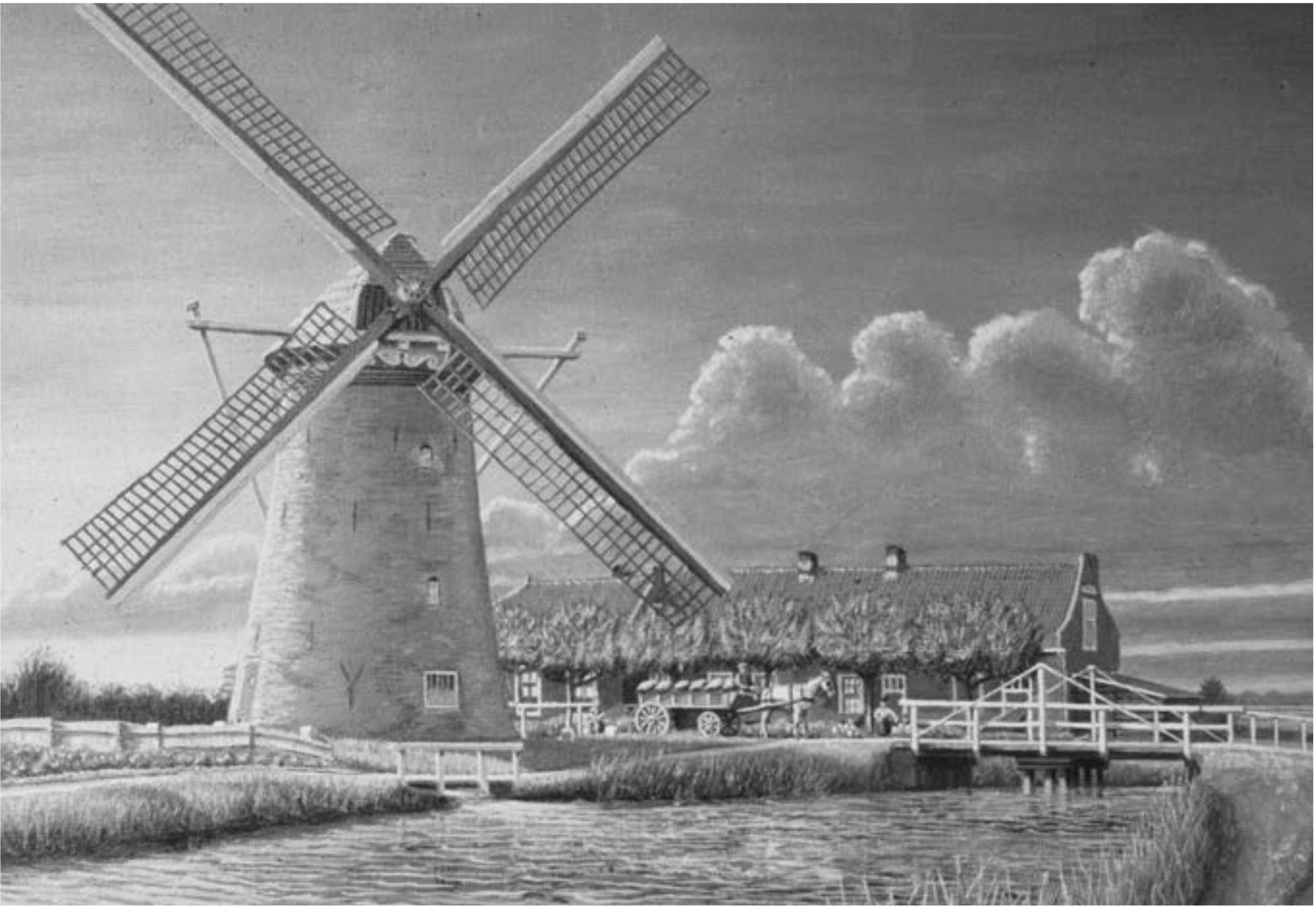
The famous French Impressionist painter Claude Monet was often found in the Netherlands to seek inspiration. Mills were one of his favorite subjects. He also painted The Vlinder in Rijnsburg.(Source: P. van Driel, May 2017)
History visible in the neighborhood
“It is great that the foundation has become part of De Horn,” says Emile. “The design of Vlieteiland has even been adjusted to make this historical find visible to everyone.
“A walking path made of natural materials has been created between the houses that leads to De Vlinder. A beautiful combination of old and new.”
Why living in this place is so special
Living in De Horn means living in a place with a story. Here, history is not hidden behind facades, but is part of daily life. You live in a modern, comfortable neighborhood, while at the same time walking on ground where people have lived, worked, and thrived for centuries.
Karel de Grotelaan 78is located in the midst of this special environment. A house where you enjoy peace, space, and comfort, with water, the park, and history literally around the corner. It is that unique combination that makes this home so special.
👉 Do you want to experience what it is like to live in a place where the past and present come together? Then contact the realtor for more information or to schedule a viewing of our house.
Source:Sales brochureDe Horn phase 2 – BPD (2020)